


Most people never think about the lock on a car door until it stops working, or until the keys are on the seat and the door has just shut. Knowing what kind of lock your car has helps when you call a locksmith, because the lock type decides how we open the door and what a repair involves. Here is a plain guide to the kinds of car door locks you will find on vehicles built in the last forty years, and what tends to go wrong with each.
Manual lock cylinders
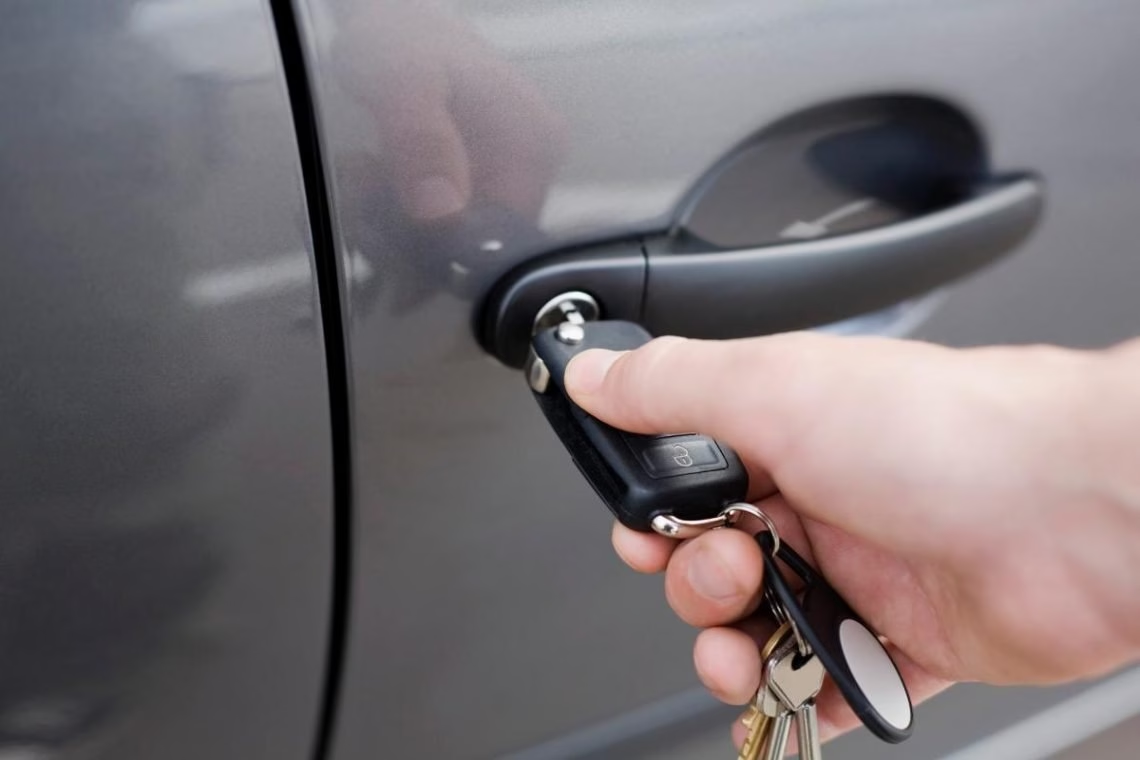
This is the oldest design and it is still on every car in some form. A keyed cylinder sits in the outside of the driver’s door, and a post or a small lever on the inside panel moves the same mechanism by hand. On older cars every door had a cylinder. On newer ones, only the driver’s door keeps it, as the backup for the day the fob battery dies.
Manual cylinders fail in a few predictable ways. The key goes in but turns without doing anything, which most often means the rod that connects the cylinder to the latch has popped off inside the door. The key will not go in at all, which is often grit, ice, a bent wafer or a chewed-up key. Or the key turns stiffly and the wafers are simply worn after years of use. We rebuild or replace the cylinder on site and key it to match your ignition key, so you are not carrying two keys for one car. See car door lock repair for that job.
Power door locks
Power locks put a small electric motor, called an actuator, inside each door. Press the switch or the fob and every actuator moves at once. Ford put the first keypad entry on a car door in 1980, and by the 1990s central locking was standard on most trims.
The tell-tale failure is one door that stays locked while the others open, or a clicking sound from inside the door with no movement. That is the actuator or its wiring, and a mechanic or body shop handles the motor. The keyed cylinder in the driver’s door is still a locksmith job, and when a power lock has you stuck outside, the way in is the same as for any other car: see car lockout service.
Remote keyless entry and fobs
Remote keyless entry uses a radio signal from the fob to tell the car to lock or unlock. Early systems used a fixed code. Everything made since the late 1990s uses a rolling code that changes with every press, which is why a lost fob cannot be cloned from a recording and has to be programmed to the car.
When a fob stops working, the battery is the first suspect. If a fresh battery does not bring it back, the fob itself has failed or lost its pairing. We program replacement fobs at the vehicle for most makes, and the key fob replacement page lists what to have ready.
Proximity and push-button start systems
A proximity system never asks you to press anything. The fob stays in your pocket, a sensor in the door handle checks for it when you touch the handle, and the car unlocks. Push-button start works the same way inside the cabin.
Two things catch people out. First, when the fob battery dies the handle sensor goes quiet, and the way in is the hidden metal key blade inside the fob, used in the keyed cylinder behind a small cap on the driver’s handle. Second, losing the only smart key means an all-keys-lost job, which takes longer than a copy because the car has to be put into programming mode without an existing key. Our car key replacement page explains how that works and which makes we cover.
Child safety locks
The small lever on the edge of each rear door is not a security lock at all. It stops the inside handle from opening the door, so a child in the back seat cannot open it while the car is moving. It is also behind one of the most common calls we get from parents: the back door that “won’t open from inside”. Flip the lever on the door edge and it opens again.
What this means when you are locked out
The lock type decides the method. On a car with a manual cylinder we can often pick the lock and leave it working as before. On most cars with power locks, a protective wedge and a reach tool let us press the unlock switch from outside without touching the paint or the glass. Either way, the goal is the same: the door opens and nothing on the car shows that it happened.
When the lock itself is the problem
A key that drags, a cylinder that spins loose, a latch that sticks, or a door that locks but will not unlock are repairs, not lockouts, and they get worse if you keep forcing them. We handle door cylinders and ignition repair at your car, so there is no trip to a shop and no tow.
If you are locked out, missing a key, down to one worn key, or fighting a lock that has stopped cooperating, call (484) 891-1922. We come to you anywhere in the Lehigh Valley, from Easton to Kutztown, and we tell you our pricing structure before we drive out.


